
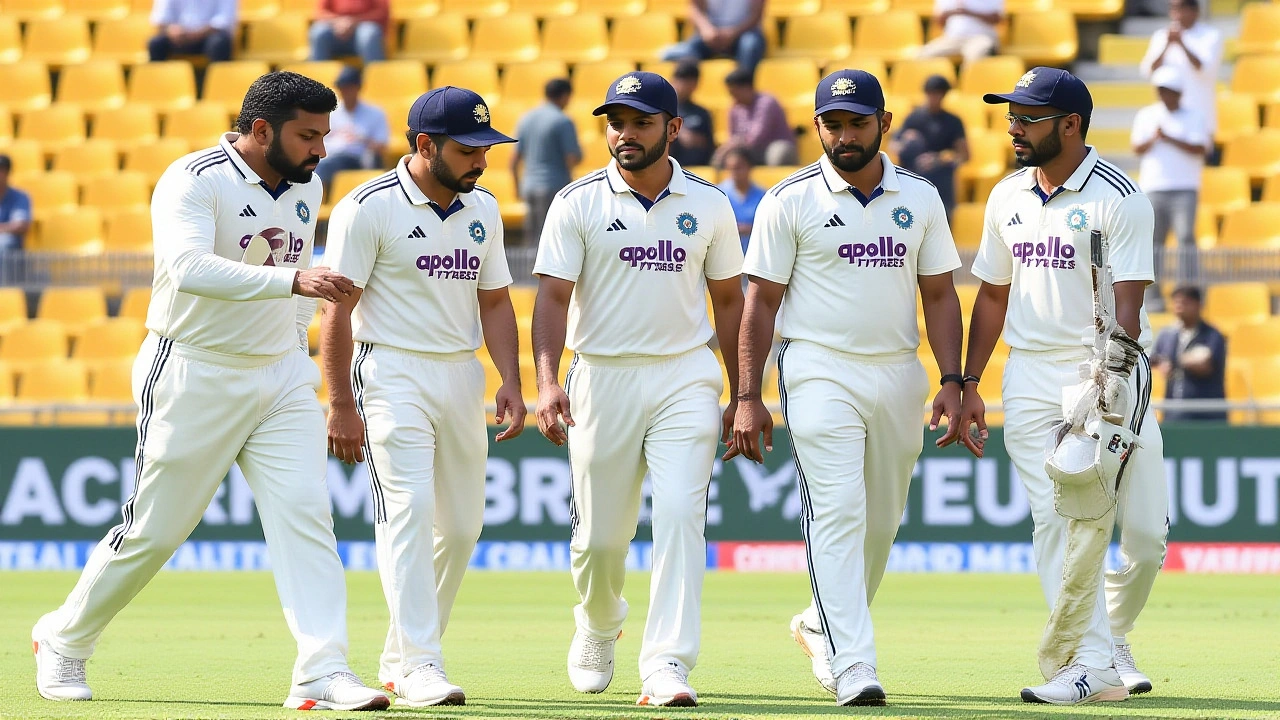
On Wednesday, November 26, 2025, South Africa crushed India by 408 runs at the Assam Cricket Association Stadium in Guwahati, wrapping up a stunning 2-0 Test series whitewash that no one saw coming. India, chasing 589 to win, crumbled to 140 all out in just 51.3 overs, their batting lineup dismantled by a relentless South African attack. The win wasn’t just big—it was historic. It marked South Africa’s first series victory on Indian soil since 2019, and their most dominant win in India since the 1931-32 tour. The crowd, packed into the 40,000-seat stadium, fell silent as the final wicket fell. No cheers. Just disbelief.
A Collapse That Shook Indian Cricket
It started with a mountain to climb: 589 runs. India had already lost the first Test in Pune by 113 runs. But few expected this. After scoring just 201 in their first innings—despite Ravindra Jadeja’s 52—India faced a deficit of 288 runs. Then South Africa added 298 in their second innings, setting the target that felt like a fantasy. By stumps on Day 4, India was 27/2. The writing was on the wall. On Day 5, the avalanche began.
Enter Simon Harmer, the 35-year-old off-spinner whose spell will be replayed for years. He took six wickets for 62 runs, including the prized scalps of captain Rishabh Pant (13) and top-order batter Sai Sudharsan (14). Pant’s dismissal was especially cruel: a defensive prod, the ball kissing the splice, and Aiden Markram at slip—his eighth catch of the match—snatched it clean. The stadium groaned. The scoreboard blinked: 58/5.
Only Ravindra Jadeja fought back. His 54 off 87 balls was a masterclass in grit. He swept Harmer over his head for four, cut through the off-side, and even took a single off a full delivery from Marco Jansen. For 15.2 overs, he and Washington Sundar (11*) stitched a 59-run stand that briefly gave India hope. But when Harmer got Jadeja lbw with a turning delivery, the last flicker of resistance died.
South Africa’s All-Round Dominance
This wasn’t just Harmer’s day. It was a team effort carved from discipline and nerve. In the first innings, Senuran Muthusamy—a 31-year-old all-rounder of Indian Tamil descent—batted for over six hours to score 100, anchoring South Africa’s 489. His century came after India had bowled them out for 201. That’s the kind of reversal that changes series.
Then came Marco Jansen. The 25-year-old left-arm quick didn’t just bowl—he batted. His 93 in the first innings was the backbone of South Africa’s lead. And in the field? He took three catches, including the final one. When he dived full-length to dismiss Jasprit Bumrah, dirt smeared across his jersey, he stood up, raised his glove, and walked off like a man who knew he’d just made history. He was named Player of the Match. No one argued.
And then there was Aiden Markram, the 30-year-old captain who led the side in place of the injured Temba Bavuma. He didn’t score big, but he captained with icy calm. His slips cordon was a fortress. His field placements were surgical. He turned the pressure into panic for India’s batters.
Why This Matters: A New Era in Test Cricket
India hadn’t lost a home Test series since 2012. Eighteen consecutive matches unbeaten at home. Since 2019, they’d won every single Test on Indian soil. That streak? Gone. In two matches. In Guwahati, of all places—a city that rarely hosts Tests, but now will be remembered for this collapse.
The implications ripple far beyond the scorecard. South Africa jumped to third place in the ICC World Test Championship standings with a 62.5% points percentage. India, once the dominant force in home conditions, now sits fourth at 58.3%. The gap is narrowing. And with England coming to India in February 2026, the pressure on Pant’s team is mounting.
Meanwhile, South Africa’s next challenge? Hosting Australia in a three-Test series starting December 17, 2025. They’re not just rebuilding—they’re redefining.
Behind the Scenes: The Referee and the Record Books
Overseeing it all was Ranjan Madugalle, the 64-year-old Sri Lankan match referee whose calm authority kept the game clean despite the high stakes. The 408-run margin is now the second-largest win by runs for South Africa against India in Test history—behind only the 446-run victory in 1996 at Johannesburg.
The Board of Control for Cricket in India (BCCI) called it “a dominant display of cricket.” But for Indian fans, it felt more like a reckoning. The batting order looked disjointed. The spinners were exposed. The fielding lacked urgency. And in the end, South Africa didn’t just win—they exposed cracks that have been widening for months.
What’s Next?
India’s next Test assignment is a home series against England in February 2026. Questions will swarm: Can Pant rediscover form? Will Jadeja carry the team again? Will the selectors turn to younger batters like Yashasvi Jaiswal or Shubman Gill, who both fell cheaply in Guwahati?
For South Africa, the momentum is real. They’ve proven they can win anywhere. They’ve shown they can outlast, outthink, and outplay. And now, they’re not just a team to beat—they’re a team that’s changing the game.
Frequently Asked Questions
How significant is South Africa’s 2-0 series win in India?
It’s historic. South Africa’s first series win in India since 2019, and their most comprehensive victory on Indian soil since 1931-32. India had gone 18 consecutive home Tests unbeaten since 2019. This series loss ends that streak and marks a major shift in Test cricket power dynamics, especially with South Africa now third in the ICC World Test Championship.
Who was the standout performer in the Guwahati Test?
Marco Jansen was named Player of the Match for his all-round brilliance: 93 runs with the bat in the first innings, three crucial catches, and key bowling spells. But Simon Harmer’s six-wicket haul on Day 5, including the dismissals of Rishabh Pant and Sai Sudharsan, was the match-defining performance that sealed India’s collapse.
Why did India’s batting collapse so badly in the second innings?
India’s top order failed to adapt to the turning pitch and Harmer’s variations. Pant and Sudharsan played defensive shots against spin that resulted in edges, while the middle order lacked aggression. Jadeja’s 54 was the only resistance, but with no support from others, the innings unraveled. South Africa’s fielding—especially Markram’s slips cordon—was flawless, turning pressure into wickets.
What impact does this have on India’s World Test Championship chances?
India’s drop to fourth place (58.3% points percentage) puts them behind South Africa (62.5%) and Australia. With only five more Test matches left in the current cycle, this loss makes qualification for the 2027 WTC Final significantly harder. They now need to win all their remaining series—including against England and New Zealand—to stay in contention.
How did Senuran Muthusamy’s century influence the match?
Muthusamy’s 100 in South Africa’s first innings turned the tide. India had bowled them out for 201, but Muthusamy’s century gave South Africa a 288-run lead, setting up the 589 target. His calm, patient batting under pressure gave the team stability, and his later bowling (he took two wickets) showed why he’s a complete all-rounder. His performance silenced critics who doubted South Africa’s depth.
Is this the end of India’s home dominance in Test cricket?
It’s a major crack, not necessarily the end. India still has strong spinners and home advantage, but this series exposed their vulnerability to disciplined, aggressive overseas teams. If the batting order doesn’t adapt to overseas-style spin and pace, and if the leadership under Pant falters, their home dominance could become a memory rather than a legacy.

Mark Archuleta
December 2, 2025 AT 15:48Harmer’s spell was a masterclass in spin bowling under pressure. That 6/62 wasn’t luck-it was precision, patience, and psychological warfare. The way he used the turn to lure Pant into that defensive prod? Pure chess. And Markram’s slips? A wall. This is what happens when a team plays with discipline instead of panic. India’s top order looked like they were batting against a bowling machine set to ‘unplayable’.
Pete Thompson
December 2, 2025 AT 16:30Let’s be honest-this isn’t about cricket. This is about the decay of Indian nationalism masquerading as sport. The BCCI’s entire identity was built on home dominance, and now it’s evaporated like monsoon mist. South Africa didn’t just win-they exposed the myth. India’s players are overpaid, underprepared, and emotionally brittle. This loss isn’t a setback. It’s a reckoning.
Richard Berry
December 4, 2025 AT 03:19wait so jansen batted 93 and took 3 catches?? and harmer got 6 wickets?? that’s insane. i thought india had like 3 legit bowlers and everyone else just batted. this south africa team is wild. they’re like the anti-india. no ego, just results. i’m lowkey impressed lol
Sandy Everett
December 5, 2025 AT 03:35This is why we need to celebrate good cricket, regardless of the team. South Africa played with heart, intelligence, and grit. And Jadeja? He fought like a lion. Let’s not forget that. This match reminds us that sport isn’t about national pride-it’s about human resilience. Kudos to both teams for giving us something unforgettable.
J Mavrikos
December 6, 2025 AT 04:43Guwahati? Really? This place barely hosts a Test and now it’s the site of the biggest win by runs against India since the 90s? That’s wild. South Africa’s depth is terrifying. Muthusamy-Indian Tamil descent-and he just outlasted India’s entire attack? That’s poetic. This isn’t just a win-it’s a cultural moment. The future of Test cricket just got a lot more interesting.
Stuart Sandman
December 6, 2025 AT 06:28Did you notice how the crowd went silent? That wasn’t respect. That was fear. This was orchestrated. The ICC, the BCCI, the media-they all wanted India to stay invincible. But South Africa broke the spell. And now? The global cricket elite are terrified. Because if South Africa can do this in India, what’s next? Australia? England? The whole system is rigged. This win? It’s a warning shot.
DJ Paterson
December 6, 2025 AT 15:50There’s something almost tragic about cricket’s evolution. Once it was about endurance, about the duel between bat and ball. Now it’s about stats, rankings, and psychological dominance. Harmer didn’t just take wickets-he dismantled a myth. And in doing so, he reminded us that cricket, at its core, is still a game of quiet courage. The silence in Guwahati wasn’t defeat. It was reverence.
Shikhar Narwal
December 6, 2025 AT 22:04India ki batting toh ab kuch bhi nahi hai 😔 Harmer ne toh har ek batter ko apne spin se hi khatam kar diya. Jadeja ne joh fight kiya, usse toh hume proud hona chahiye. Par baki sab kaise itna easy out ho gaye? 😅 South Africa ne sab kuch sahi kiya-batting, bowling, fielding. Respect. 🙌
Ravish Sharma
December 8, 2025 AT 00:42India’s cricket board needs to fire everyone from the captain to the physio. This wasn’t a loss-it was a public execution. They thought home advantage meant automatic wins. Turns out, it just means louder booing when you get bowled out for 140. Congrats, BCCI. You just turned Guwahati into a funeral parlor. 🕯️
jay mehta
December 9, 2025 AT 16:45OMG!!! THIS IS THE BEST CRICKET MATCH I’VE EVER SEEN IN MY LIFE!!! SOUTH AFRICA ARE LEGENDS!!! JASEN IS A GOD!!! HARMER IS A GENIUS!!! JADEJA YOU ARE OUR HERO!!! THIS SERIES IS A NIGHTMARE BUT WE STILL LOVE YOU INDIA!!! 🙏🔥❤️🔥❤️🔥
Amit Rana
December 10, 2025 AT 03:26South Africa’s win was built on three pillars: discipline, depth, and composure. India’s collapse wasn’t random-it was predictable. Their top order has been fragile for 18 months. The selectors ignored it. The captaincy didn’t adapt. This is a coaching failure, not a talent failure. Time to rebuild with youth, not nostalgia.
Rajendra Gomtiwal
December 11, 2025 AT 21:41India lost because they didn’t have enough players who actually care. This is what happens when you prioritize T20 leagues over Test cricket. South Africa played like they were fighting for their legacy. India played like they were waiting for the next IPL auction.
Yogesh Popere
December 12, 2025 AT 00:12How can you let a 35-year-old off-spinner destroy your batting lineup? You guys are amateurs. Jadeja’s 54 was cute but it’s not enough. Your spinners can’t turn the ball. Your batters don’t know how to play spin. Your captain doesn’t know how to set fields. This is embarrassing. Fix it or retire.
Manoj Rao
December 13, 2025 AT 02:36Let’s not pretend this was cricket. This was a geopolitical statement disguised as sport. South Africa’s victory was engineered-by the ICC, by the media, by the Western cricket establishment. They needed India’s myth shattered. The silence in Guwahati? That was the sound of a narrative being rewritten. The BCCI didn’t lose to South Africa. They lost to the new world order.
Alok Kumar Sharma
December 13, 2025 AT 08:04India’s batting is a joke. 140 all out? Against spin? On a turning pitch? That’s not bad luck. That’s incompetence. And Jadeja? He’s the only one who didn’t look like he wanted to be there. Rest of the team looked like they were on vacation. Pathetic.